Medicaid. Social Security. Disability Programs. Education. Federal Budget. Join us every Friday from 9-10:30 am to get the latest on Federal funding cuts and federal agency changes that impact people with disabilities.
Register for our next (9-10:30 AM Friday, October 9th) federal funding webinar (English, Spanish)
This webinar is limited to the first 500 people who log on. BPDD is committed to making its resources as accessible as possible. If you need interpretation to participate in this webinar, please indicate that when registering and let us know by noon each Tuesday before the webinar.
The presentation will be recorded. All people who register will get a follow up email after the webinar with a link to the presentation slides, recording, new questions you can ask, and direct links to all the articles/resources in the slides.
When you register, you will receive another e-mail with the zoom link for the webinar. Please note, some people have reported issues with phones and tablets showing all screens (ASL interpreters, speaker, and screen share).
Resources from Last week's webinar
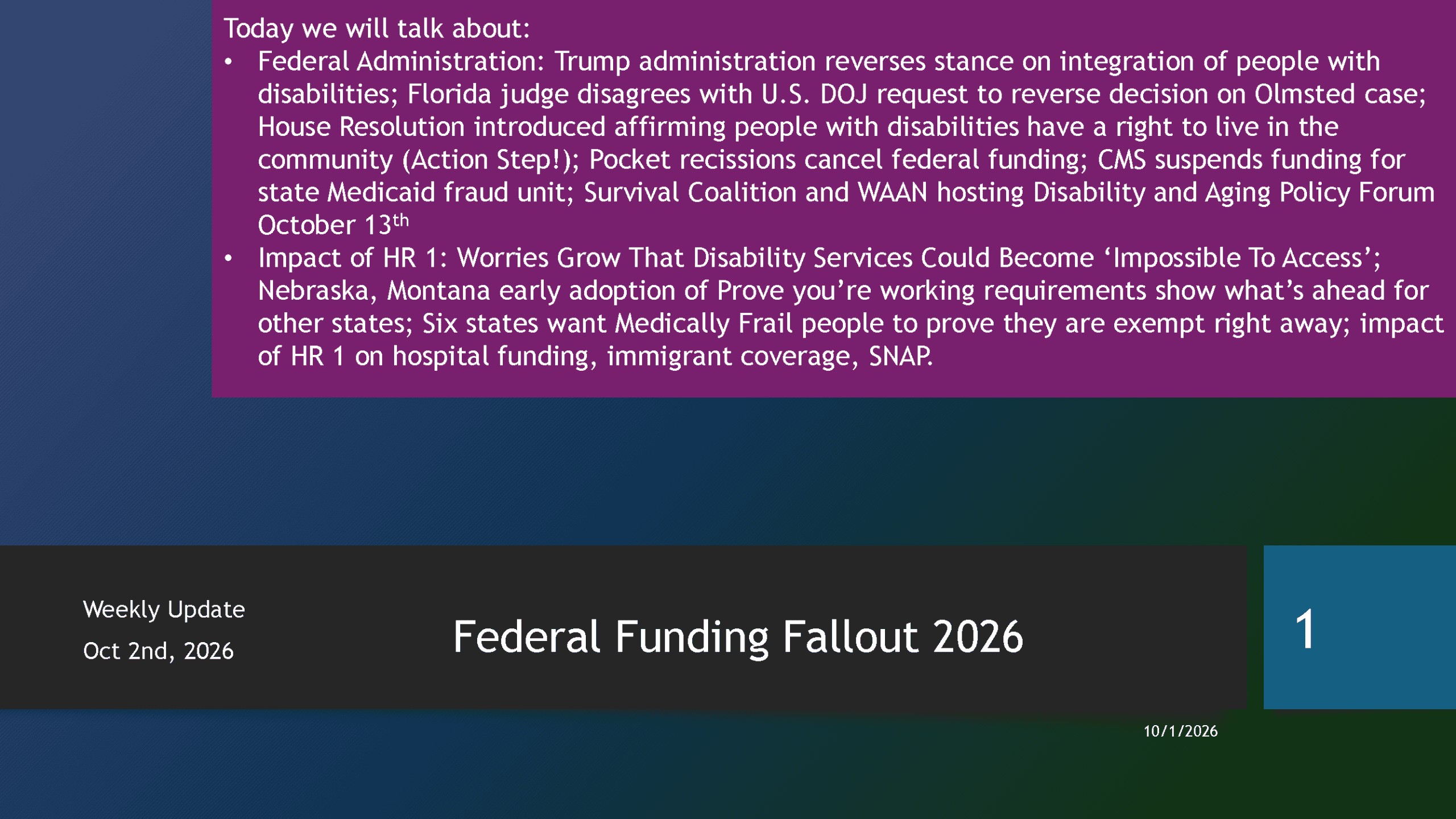
On October 2nd we talked about:
-
Policy changes the administration is making:
-
Trump administration reverses stance on integration of people with disabilities;
-
Florida judge disagrees with U.S. DOJ request to reverse decision on Olmsted case;
-
House Resolution introduced affirming people with disabilities have a right to live in the community (Action Step!);
-
Pocket recissions cancel federal funding;
-
CMS suspends funding for state Medicaid fraud unit;
-
Survival Coalition and WAAN hosting Disability and Aging Policy Forum October 13th
-
-
Continued coverage of impacts of HR
- Worries Grow That Disability Services Could Become ‘Impossible To Access’;
- Nebraska, Montana early adoption of Prove you’re working requirements show what’s ahead for other states;
- Six states want Medically Frail people to prove they are exempt right away;
- impact of HR 1 on hospital funding, immigrant coverage, SNAP.
Links to articles included in the presentation
Tools you can use
- Survival Coalition
- Survival Coalition and WAAN hosting Disability and Aging Policy Forum October 13th (livestream @ https://www.facebook.com/WisconsinBPDD or https://www.youtube.com/@WBPDD)
- Survival Coalition, recording of Medical Aid in Dying issue forum
- Survival Coalition statewide survey on special education experiences in Wisconsin
- Tools you can use
- Federal administrative changes
- Trump administration reverses stance on integration of people with disabilities (NPR, Disability Scoop)
- Florida judge disagrees with U.S. DOJ request to reverse decision on Olmsted case
- House Resolution introduced affirming people with disabilities have a right to live in the community
- Administration uses rescissions to revoke $810M approved by Congress (News from the States, NPR, AP)
- Unclear if more federal funding has been withheld
- Civil rights enforcement cuts mean fewer staff, closed offices, longer waits
- New York: feds suspend funding for state fraud unit
- Continued coverage of impact of HR 1
- Worries Grow That Disability Services Could Become ‘Impossible To Access’
- CBO: National Medicaid work requirements could strip coverage from 8 million
- Nebraska’s Early Work-Requirement Data Offers a Preview for Other States (Kaiser Health News, Georgetown)
- Montana: Confusion and worry Follow Early Rollout of Medicaid Work Rules
- Six States Tell Patients To Prove They’re Too Sick For Medicaid Work Requirement in Jan.
- North Dakota: Passing Medicaid ballot measure would reduce services and spike insurance costs
- Doctors and hospitals to see lower Medicaid payments in 3 dozen states
- At least 100,000 legal immigrants will lose Medicaid coverage Oct 1st under HR 1
- SNAP’s funding model is starting to change. Here’s what that means for the program
- Michigan school districts, food pantries feel SNAP cut ripple effect ahead of cost shift to states